Guides · Bases and assembly
Shed base options compared
Compare concrete, paving slabs, timber frames, plastic grids and ground screws for a level, drained shed foundation, with dated UK price bands from named retailers.
Affiliate links: We earn from some links to Wickes through the Awin network. You do not pay more, and it does not change what we recommend. How this works.
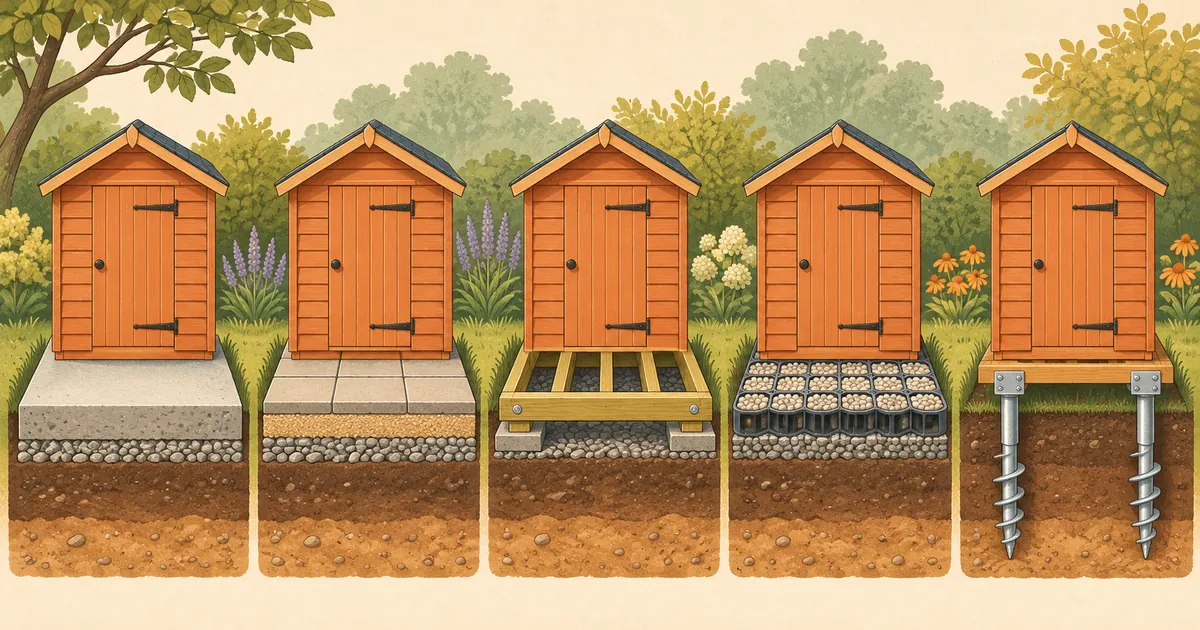
The base is the least glamorous part of any shed project, and the one that decides whether the doors still shut in three years' time. Get it level, firm and dry and the shed above gets an easy life. Skimp on it and you can end up with sticking doors, gaps in the roof and a floor that slowly turns to porridge. The good news: there are five sensible options, and at least one will suit your garden, your budget and your patience for digging. Here's how they compare, with prices from named UK retailers so you can see roughly where the money goes.
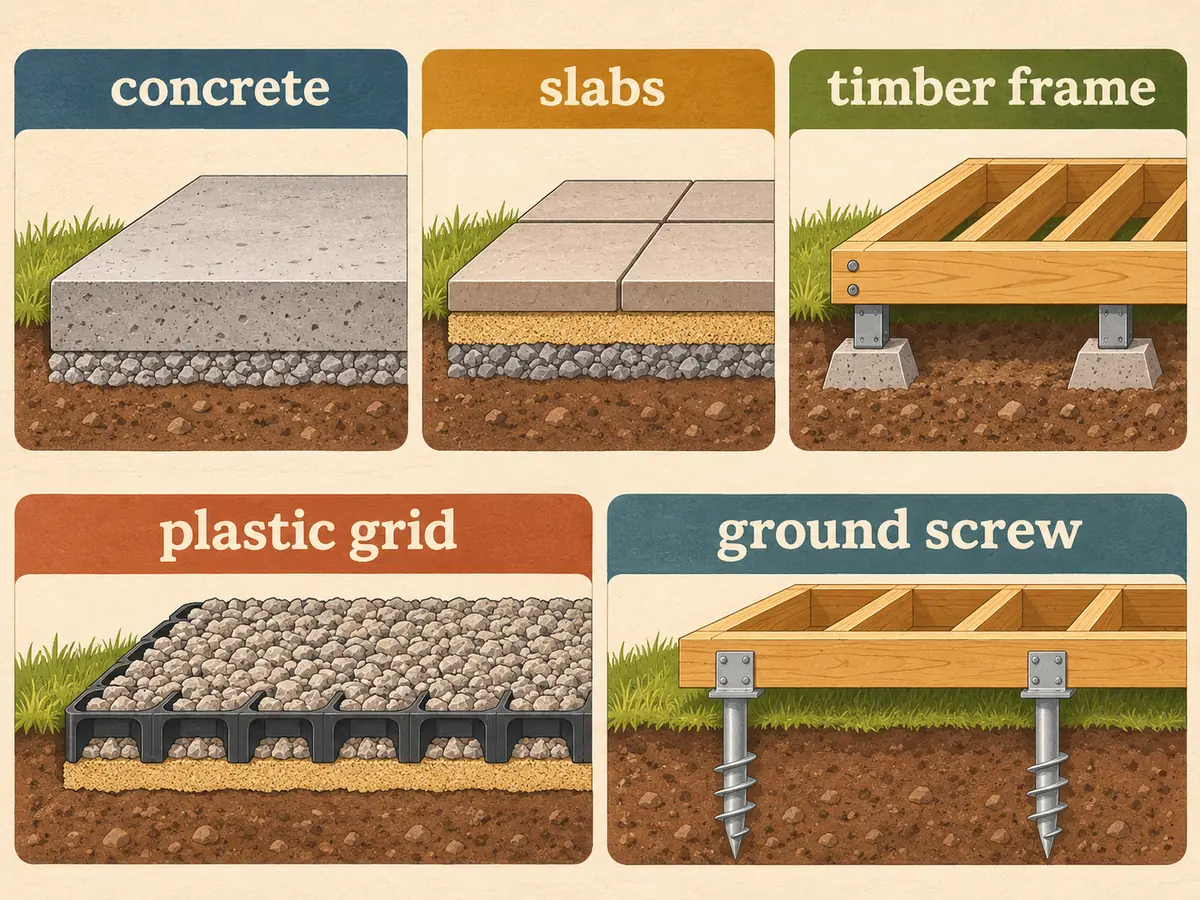
What a shed base has to do
A base has three jobs: hold the shed level, stop it sinking, and keep the timber away from standing water. Waltons' shed base guide explains that if a shed goes up on an uneven surface the timbers flex, so screw holes and joints may not line up and doors and windows may not close properly. It also says a base stops groundwater seeping into the bearers.
Forest Garden is blunt about grass. Its shed assembly tips say sheds should not simply be put up on grass or soil, and the Forest section of the Wickes garden installation service page says Forest buildings cannot be installed on grass, soil, loose gravel or other loose surfaces. There's more on that in our answer to can I put a shed on grass?
How level is level enough? The same Wickes page says, for Forest installations, that a slope of more than 15 mm from edge to edge will cause twisting and gaps in the sections, roof, doors and windows. That's a useful target for any timber shed, whichever base you choose.
Base options at a glance
Prices below were checked on 15 November 2026 at the named retailers and are for the specific products listed. They exclude delivery, hardcore, tools and labour unless stated.
| Base | Good fit | Example product and price | Watch for |
|---|---|---|---|
| Concrete slab | Heavy or long-term buildings, workshops | Built from materials; see the worked example below | Most digging, curing time, permanent |
| Paving slabs | Most small and medium sheds | 600 x 600 x 38 mm slab about £10.70 each at Wickes | Needs a compacted sub-base and continuous coverage |
| Treated timber frame | Quick builds, slightly uneven or soft ground | Forest Garden 8 x 6ft base about £95 at Wickes | Needs firm, level ground or packing beneath |
| Plastic grid | Light to medium sheds, good drainage | EcoBase 8 x 6ft kit about £149 at Wickes | Ground prep still matters; follow load guidance |
| Ground screws | Little excavation, removable | Shire Gorilla 1.2 x 2.4 m kit about £594 listed on B&Q | Highest price for small sizes; soil must suit |
Concrete slab
Concrete is the most permanent option. Forest Garden's advice on the Wickes installation page calls it "by far the best material for any size base", ideally on a good dressing of sharp sand and hardcore for drainage, and Shire's section of the same page says its bases should ideally be concrete over hardcore.
Waltons' step-by-step guide digs out for at least 10 cm of compacted hardcore plus 15 cm of concrete, uses a timber frame (formwork) to hold the concrete, checks the diagonals are equal so the base is square, and leaves the slab for at least three days before removing the frame and building. It suggests working out volume as depth x width x length and adding 10% contingency. Waltons recommends a builder if you're not confident with DIY.
Here's why bagged concrete rarely makes sense for a whole base. Wickes says one 20 kg bag of Blue Circle Multi-Purpose Ready To Use Concrete typically makes around 0.01 m³ of concrete, at about £11.20 a bag (checked 15 November 2026). A 2.4 x 1.8 m slab at 15 cm deep is about 0.65 m³; add 10% and it's roughly 0.71 m³, or around 71 bags. That's a lot of lifting and around £800 in bags alone, so most people mixing their own buy cement and aggregate in bulk, or order ready-mixed concrete. Our shed base calculator does the volume sums for your size.
Paving slabs
Slabs are the classic DIY base and, per Waltons, suitable for all garden buildings if the ground is prepared properly. Its method: dig out for 10 cm of hardcore, 2.5 cm of mortar and the slab thickness so the slabs sit just below the turf; compact the hardcore; dry-lay the slabs with spacers; then bed them on mortar and leave up to 48 hours to harden before pointing the joints.
The Forest guidance on the Wickes page says slabs should form a continuous base with no large gaps between them. That rules out the "four slabs under the corners" shortcut for a shed with a full floor.
Costs for a shed around 8 x 6ft, using a 2.4 x 1.8 m base laid as 4 x 3 slabs:
- Slabs: 12 of the Marshalls Richmond Smooth Natural Paving Slab - 600 x 600 x 38mm at Wickes, about £10.70 each, so about £128 (checked 15 November 2026). Wickes lists each one at 32 kg, so plan the carrying.
- Bedding: Wickes says one 20 kg bag of Blue Circle Ready To Use Slablayer covers 0.4225 m² at 25 mm deep, at about £8.20 a bag. A 4.32 m² base needs about 11 bags, or around £90.
- Plus: hardcore, sharp sand or jointing, and tool hire if you need a plate compactor. Prices for these vary by area and pack size, so check your local branch.
Treated timber frame
A timber frame is a grid of pressure-treated bearers that the shed sits on. It's quick, lifts the shed off the ground and copes with a bit of unevenness if you pack it carefully.
The Forest Garden Shed Base - 8 x 6ft at Wickes is listed at about £95 (checked 15 November 2026). Wickes describes it as incised and UC4 pressure treated for ground contact, measuring 2360 x 1826 mm and weighing 37 kg, and says it should be laid on level ground or propped with suitable material on uneven ground. Forest's own tips say these bases can be assembled onto hardcore. For larger buildings, Wickes lists the Powersheds Pressure Treated Garden Building Base Kit - 12 x 8ft, made from 90 x 45 mm bearers, at about £373.
Waltons sells a similar Portabase kit supplied with ground spikes and brackets, which it says suits both lawns and hard surfaces. A raised frame needs airflow underneath, so don't bank soil or gravel up against it. Our guide to pressure-treated vs dip-treated timber explains what the treatment does and doesn't do.
Plastic grid
Interlocking plastic grids are light, drain freely and need less digging than slabs. The EcoBase Fastfit System Shed Base for 8 x 6ft Sheds is about £149 at Wickes (checked 15 November 2026). Wickes lists it at 2500 x 2000 x 40 mm and 28 kg, supplied with a weed-resistant membrane, and says gravel isn't needed across the whole base, with pea gravel optional around the edge as a French drain. The listing quotes a load figure per grid; that's the maker's claim, so read the instructions for your shed and ground.
A budget alternative is the Wickes Interlocking Ground Grid Shed Base - 50 x 50cm - Pack of 4 at Wickes, about £24 a pack. Wickes recommends five packs for a 6 x 8ft shed, so roughly £120 before gravel. The ground underneath still needs to be firm and level, and the grids are only as flat as what they sit on.
Ground screws
Ground screws are steel helical piles driven into the ground, with a frame fixed on top. They mean very little excavation and can be removed later. The Shire Gorilla Garden Building Base ground screw kit on B&Q's website is listed at about £594 for a 1.2 x 2.4 m frame (checked 15 November 2026), including screws, a pre-cut timber frame, fixings and a driving tool. That makes it the priciest option here for a small shed. Stony ground, roots or buried services can get in the way, so check the kit's ground guidance and know what's under your lawn before you start.
Size, clearance and other details
- Size to the maker's drawing. Mercia's section of the Wickes installation page says its base must be no bigger than the building. Measure the floor footprint, not the roof: Forest's shed buying guide says to know the footprint for the base and to allow for extra dimensions such as roof overhangs.
- Leave working room. On the same page Mercia asks for about 60 cm around the building, Shire for 18 inches (450 mm) and Forest for at least 2 ft. Waltons suggests leaving about 3 ft between the shed and walls for maintenance and airflow.
- Square matters. Check that both diagonals are the same length before anything sets or is screwed down.
- Anchoring. Check whether your shed's instructions call for fixing it down to the base, and plan the base so fixings have something solid to bite into. See should I anchor a shed?
Which base for which garden?
- Flat lawn, average timber shed, keen DIYer: paving slabs or a timber frame on compacted hardcore.
- Heavy workshop, machinery or long-term building: a concrete slab, possibly laid by a builder.
- Damp or poorly drained spot: a raised timber frame or plastic grid, with attention to drainage. Our guide to damp and condensation in sheds has more.
- Rented home or you may move the shed: plastic grid or ground screws.
- Small slope: a timber frame packed level, or ground screws; steeper slopes may need a builder.
For a quick comparison of the two most popular options, see concrete or slabs for a shed base?
The bottom line
There's no single best shed base, but there is a best one for your garden. Slabs and timber frames suit most sheds on a sensible budget, concrete earns its keep under heavy loads, and grids and ground screws trade cost for less digging. Whichever you choose, aim for level, firm and well drained, and your shed will thank you by keeping its doors on speaking terms with their frames.
Sources
- Wickes: garden installation service (Mercia, Shire and Forest base requirements)
- Forest Garden: help and support
- Forest Garden: shed project guide and top tips
- Forest Garden: buying guide to garden sheds
- Waltons: how to build a shed base
- Wickes: shed bases category
- Wickes: Forest Garden Shed Base - 8 x 6ft
- Wickes: Powersheds Pressure Treated Garden Building Base Kit - 12 x 8ft
- Wickes: EcoBase Fastfit System Shed Base for 8 x 6ft Sheds
- Wickes: Interlocking Ground Grid Shed Base, pack of 4
- Wickes: Marshalls Richmond Smooth Natural Paving Slab 600 x 600 x 38mm
- Wickes: Blue Circle Ready To Use Slablayer 20kg
- Wickes: Blue Circle Multi-Purpose Ready To Use Concrete 20kg
- B&Q: Shire Gorilla ground screw shed base kit