Guides · Materials
Overlap vs shiplap vs tongue-and-groove cladding
What overlap, shiplap and tongue-and-groove shed cladding actually mean, the board thicknesses UK makers publish, and the specs that matter beyond the label.
Affiliate links: We earn from some links to Wickes through the Awin network. You do not pay more, and it does not change what we recommend. How this works.
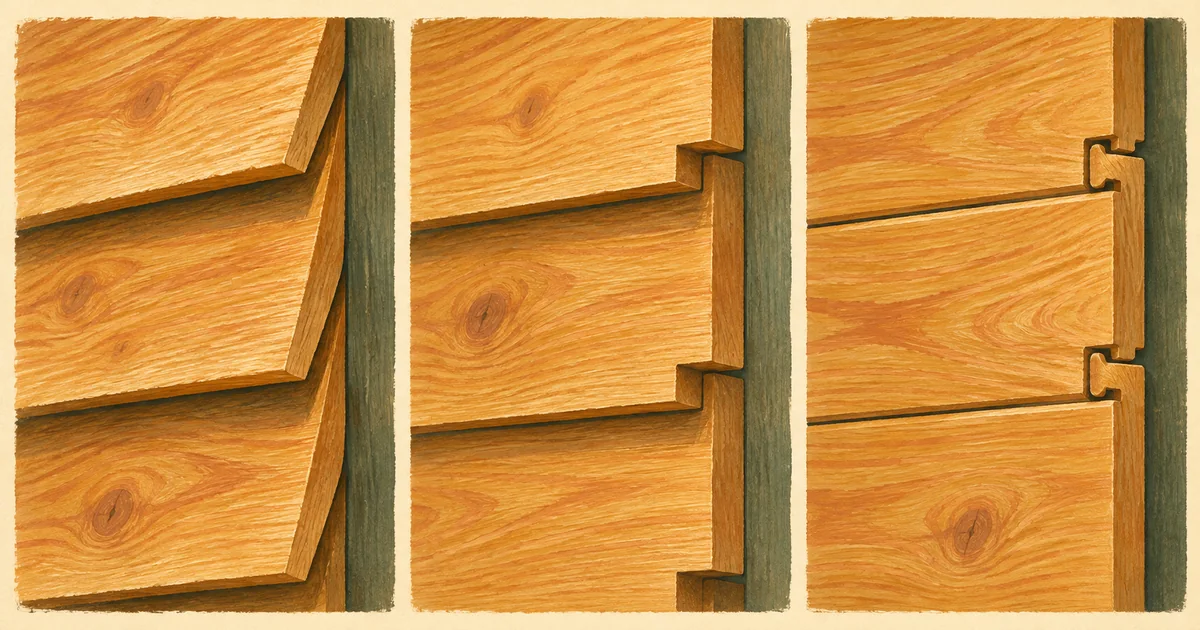
Shed listings love a cladding word. Overlap, shiplap, tongue-and-groove: they sound like boat-building jargon, and to be fair, two of them more or less are. But the cladding is the skin of your shed, so it decides how draughty, how stiff and how weather-tight the walls will be, and how much they'll creak and gape as the seasons turn. Here's what the terms mean, what UK makers actually publish about them, and what to check before you hand over your money.
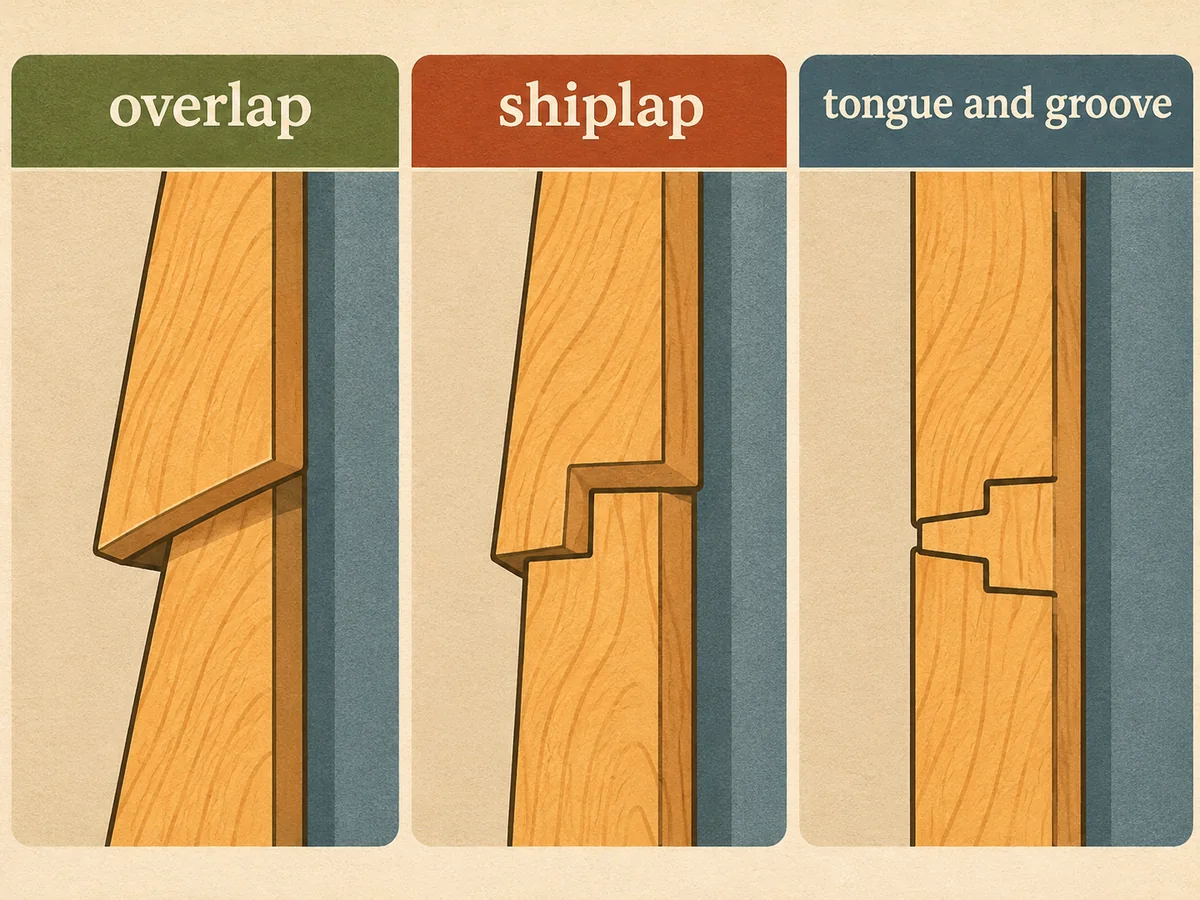
The three profiles in plain English
Overlap. Rough-sawn boards fixed so each one laps over the top of the board below, like a row of roof slates turned on their side. Forest Garden describes overlap as square-cut boards that let rainwater run off and allow the timber to move as temperature and humidity change. It adds that overlap boards don't form a closed seal, so they are more prone to moisture and draughts, which it says isn't a problem for garden storage (Forest Garden buying guide).
Shiplap. Smooth-planed boards that interlock, with a shaped (scalloped) profile on the face of each board to shed water. Forest Garden says its shiplap boards use tongue-and-groove joints, which is why the two terms often blur in retail listings (Forest Garden). Waltons also calls its version "pressure treated shiplap cladding" made from tongue-and-groove boards (Waltons).
Tongue-and-groove (flat profile). Interlocking boards with a flat face for a cleaner, more contemporary look. Forest Garden describes its tongue-and-groove sheds as giving good protection from wind and rain thanks to the tight-fitting construction (Forest Garden).
Board thickness: what the makers publish
| Maker (published spec) | Overlap | Shiplap | Tongue-and-groove |
|---|---|---|---|
| Forest Garden | 7mm boards | 12mm boards | 12mm smooth-planed boards |
| Mercia | 7mm boards | 12mm interlocking tongue-and-groove boards | Not listed separately |
| Waltons | 10mm panels | 12mm tongue-and-groove boards | Not listed separately |
All figures from the makers' own buying guides, checked 15 November 2026. Two things jump out. First, "overlap" isn't one thickness: two of these makers publish 7mm and one publishes 10mm. Second, at this level, shiplap and tongue-and-groove sheds from these makers share the same 12mm board thickness, so the difference between them is mainly profile and look, not bulk. Always read the spec on the exact model rather than assuming.
How each behaves through the year
Forest Garden's care guidance is refreshingly candid: movement and gaps in timber are normal, and you'll see more movement in overlap construction because the cladding has more room to move. Shiplap and tongue-and-groove are more stable because the boards interlock, though they can still shrink in hot weather. Splits along the grain in spring and summer are described as normal and usually close again. Pre-drilling during assembly reduces splitting.
So if you notice daylight between overlap boards in a dry August, that's the material doing what it does rather than a fault. If you need a wall that stays tight, buy interlocking boards. The same guide notes that wood naturally swells again in winter, so a gap you spot in summer may well have closed by the time the clocks go back; it's worth checking again before reaching for the filler.
What the label doesn't tell you
A cladding name says nothing about:
- Frame size and spacing. The boards are nailed to a framework; a stiffer frame matters as much as the boards when you hang shelves or tools.
- Floor and roof. Forest Garden says its dip-treated overlap sheds come with sheet-material floors, while pressure-treated overlap and shiplap sheds have fully boarded floors (Forest Garden). Waltons recommends upgrading to 12mm tongue-and-groove floor and roof boards if you'll spend a lot of time inside or store heavy items (Waltons).
- Treatment. The cladding style and the preservative treatment are separate choices. Waltons says its sheds are dip treated as standard with a water-based colourant that is not a preservative, so they need a preservative and waterproofing coat soon after construction to validate the guarantee (Waltons). See pressure-treated vs dip-treated.
- Guarantee conditions. Forest Garden's guarantee requires installation in line with its assembly instructions, keeps dip-treated products out of ground contact, and requires annual re-treatment of dip-treated products.
Which cladding for which job?
| Use | Sensible starting point | Why |
|---|---|---|
| Garden tools, mower, bags of compost | Overlap | Cheapest; Forest Garden says draughts aren't a problem for storage |
| Bikes and power tools | Shiplap or tongue-and-groove | Tighter, stiffer walls; pair with better doors and locks |
| Potting shed or hobby space | Shiplap or tongue-and-groove with boarded floor | More stable walls, better for fitting benches |
| Exposed, windy site | Interlocking boards | Forest Garden and Mercia both describe better weather protection |
Mercia describes overlap as the most affordable and straightforward option and shiplap as giving a more robust finish with better weather protection (Mercia); Waltons broadly ranks value (overlap), standard (shiplap) and premium (shiplap with tongue-and-groove roof and floor) sheds the same way (Waltons). For a shed you'll work in, see the wider shed buying guide.
Build it so the cladding can do its job
Forest Garden's shed assembly guide points out that wall panels have a top and a bottom: the bottom board overlaps the frame so that, once fitted, it laps over the edge of the floor and covers the joint, keeping rain out. Fit a panel upside down and you've built a water trap. The same guide suggests running mastic sealant down corner joints before fixing the corner strips, and pre-drilling pilot holes so thin trims don't split.
Then keep the walls in good shape:
- Keep soil, mulch and plants off the bottom boards; Forest Garden says vegetation touching the building can act as a conduit for moisture (care guide).
- Keep the treatment up as the guarantee requires. A coloured, water-repellent shed-and-fence finish such as Cuprinol 5 Year Ducksback Matt Shed & Fence Treatment - Forest Green - 5L at Wickes (about £19 for 5 litres at Wickes, checked 15 November 2026) colours and weatherproofs; check whether your shed's guarantee asks for a preservative as well, and follow the tin.
- Fix roof and gutter leaks quickly, and never block the vents to make the shed "airtight". See damp and condensation in sheds.
- On delivery, follow the maker's procedure for recording damaged boards before you build.
The bottom line
Overlap is a perfectly honest choice for a tool store, as long as you accept a bit of seasonal movement and the odd chink of light. If you want tighter, steadier walls, or you'll be spending time inside, the step up to interlocking shiplap or tongue-and-groove is usually money well spent. Either way, read the thickness, floor, treatment and guarantee lines on the spec sheet: the cladding word is only the start of the story.