Guides · Choosing a shed
Apex vs pent vs reverse-apex sheds
Choose between apex, pent and reverse-apex sheds by headroom, door position, drainage, boundary height and garden layout, with a like-for-like spec comparison.
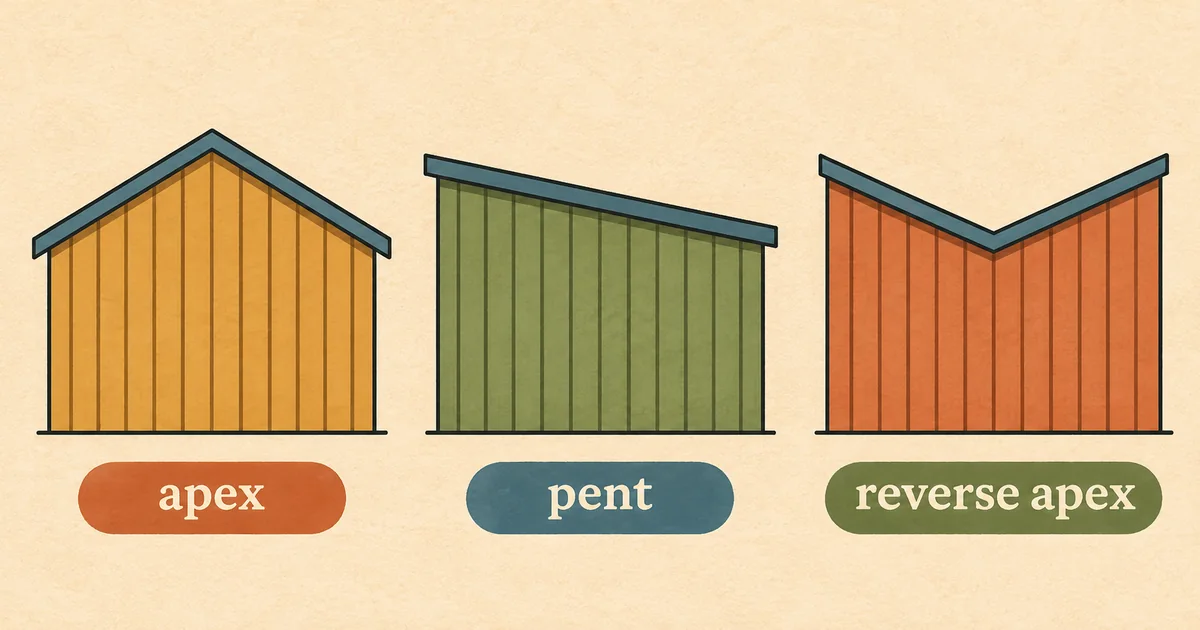
Roof shape sounds like a matter of taste, and partly it is: some people want a proper little pitched-roof shed with a pointy front, others want something low and neat that tucks behind the fence. But the roof also decides where you can stand up, where the door goes, which way the rain runs and how tall the shed is next to your neighbour. Pick well and the shed fits the garden like it was always there. Pick badly and you'll be stooping past the lawnmower for the next decade. Here's how the three common shapes compare.
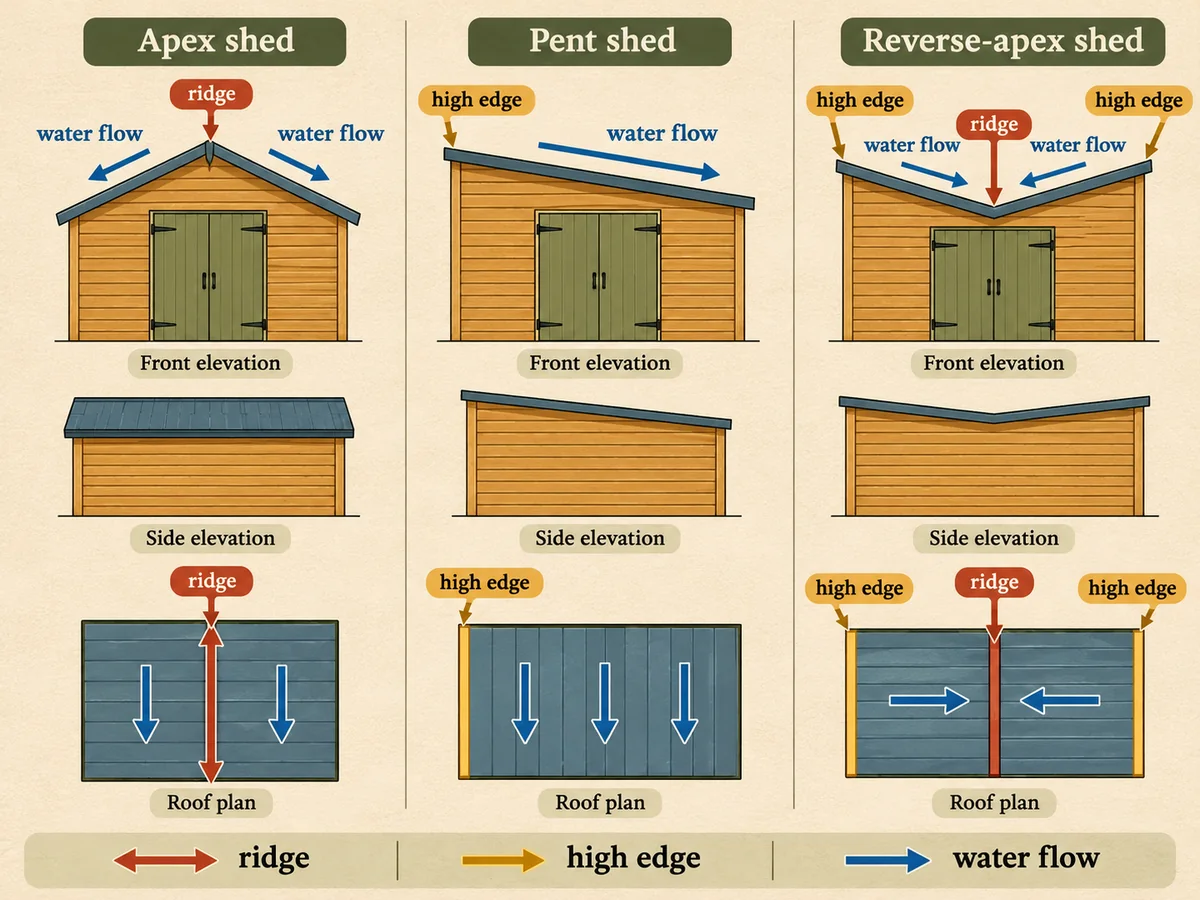
The three shapes in plain English
Makers use these names fairly consistently. Forest Garden's buying guide to garden sheds and Waltons' shed buying guide describe them like this:
- Apex: a ridge runs along the length of the shed with a roof slope on each side, so the highest point is in the middle. The door is usually in the gable end, under the point of the roof.
- Pent: a single sloping roof panel. Forest says it usually slopes down towards the back; Waltons describes it as sloping from front to back, giving height for the door at the front and letting rain run off the back.
- Reverse apex: an apex roof turned round so the ridge runs the other way. Forest says the door and any windows sit on the wider side of the building rather than at the end under the ridge.
Waltons also mentions curved and barn-style roofs, but apex, pent and reverse apex are the three you'll see most often.
How they compare
| Feature | Apex | Pent | Reverse apex |
|---|---|---|---|
| Highest headroom | Down the centre aisle | At the high (usually front) wall | Down the centre, along the length |
| Door position | Usually the narrow gable end | Usually the high side | Usually the long side |
| Rain runs | Off both sides | Off one side, usually the back | Off the front and back |
| Against a fence | Possible, but one roof edge drips near it | Often a good fit, low side to the fence | Possible, depending on door access |
| Storage layout | Shelves at sides and back, clear centre aisle | Shelving at the back, bench at the front | Storage either side of a central door |
| Look | Traditional | Contemporary and low | Traditional, cottage-style front |
Apex: headroom where you walk
The apex is the shape most people picture when they hear "shed". Forest says its central high point makes it practical for storing equipment at the sides and back while keeping a clear aisle down the middle, and Waltons notes that the best head height is central, which suits people who plan to work inside.
Points to check:
- Ridge vs eaves. All that height is in the middle. Near the side walls you only get the eaves height, so tall shelving belongs at the back wall under the gable.
- Window side. Forest's shed assembly tips say most of its apex sheds with a window can be built with the window panel on either side. Check your model before you assume the photo shows the only layout.
- Gable-end door. Great for wheeling things straight down the aisle, less great if the narrow end faces a fence.
Pent: low, tidy and fence-friendly
A pent roof keeps the overall height down and sheds rain in one direction. Forest says pent sheds suit being put against a wall or fence and work well when the main job is storage, or for a potting bench at the front. Waltons says much the same.
Points to check:
- Which wall is high? Usually the front, but confirm on the drawing: photos can be misleading. If you want the water to fall into a border or a water butt rather than your neighbour's garden, the slope direction matters. See which way should a pent roof slope?
- Shallow fall. Some pent roofs slope only gently, so look at the difference between the high and low wall heights on the spec. Whatever the pitch, keep it clear: Forest's tips warn that leaves left to rot on a shed roof can damage the felt.
- Headroom drops towards the back. Fine for storage, less fine if you want to stand at a back-wall bench.
Reverse apex: door on the long side
Turn an apex round and you get the reverse apex. Forest says this suits smaller sheds in particular, because on a narrow apex shed it can be hard to keep a central aisle clear while using the sides and back for storage. With the door in the long side, everything is within an arm's reach or two of the entrance.
It also suits a wide, shallow plot where the long side faces the house or path. Waltons describes the ridge as running side to side, so there's comfortable headroom in the middle. Do check the eaves height over the doorway, because on a reverse apex the door sits in an eaves wall rather than a gable.
A like-for-like spec comparison
Forest sells the same Beckwood 6x4 shiplap, pressure-treated shed in all three roof shapes, which makes a handy comparison. These figures come from Forest's product pages (checked 15 November 2026). The apex version listed has a double door while the other two have single doors, so the door widths and weights aren't perfectly like for like.
| Beckwood 6x4 (Forest) | Apex | Pent | Reverse apex |
|---|---|---|---|
| Footprint (w x d) | 182 x 118 cm | 182.6 x 118 cm | 182.6 x 118 cm |
| Ridge height | 224 cm | 202.3 cm | 212.2 cm |
| Eaves height | 186 cm | 188.5 cm | 186.4 cm |
| Overall w x d including overhangs | 198 x 122 cm | 197.8 x 140.1 cm | 188.2 x 134.2 cm |
| Door opening (h x w) | 164 x 109 cm (double) | 164.5 x 59 cm | 164.5 x 59 cm |
| Estimated weight | 170 kg | 128 kg | 140 kg |
| Forest RRP (store and home delivery) | £567.49 | £561.49 | £536.49 |
What this shows:
- Same footprint, different heights. On these three, the apex stands about 22 cm taller than the pent, which matters near a boundary.
- Overhangs change the real size. The pent's overall depth is about 22 cm more than its footprint. Allow for that when you measure the gap to a fence, path or wall.
- Eaves are similar. The extra height on the apex is all in the middle, so headroom at the walls is much the same across the three.
- Doorways barely differ in height. All three openings are around 164 cm high, so a tall person will duck on any of them. Forest's buying guide suggests checking door height and opening width before you buy.
Roof shape and the planning height limits
In England, the Planning Portal lists, among other conditions, a maximum eaves height of 2.5 metres, a maximum overall height of 4 metres for a dual-pitched roof or 3 metres for any other roof, and a 2.5 metre maximum when the building is within 2 metres of a boundary.
The government's technical guidance adds detail that matters here. Height is measured from the highest ground level next to the building. The 4-metre dual-pitched limit also applies to hipped roofs. A single-pitched (pent) roof falls under the 3-metre limit, with the 2.5-metre eaves cap still applying. So an apex and a reverse apex are "dual-pitched", and a pent is not.
For most sheds, though, the boundary rule is the one that bites. Tuck any shed within 2 metres of the fence and the limit is 2.5 metres overall, whatever the roof shape. Meeting these figures doesn't by itself make a shed permitted development: position, land coverage, listed status, designated land and removed rights all count. It may be likely permitted development, so check with your council if in doubt. Scotland, Wales and Northern Ireland have their own rules. Our shed planning rules guide goes through the full checklist.
Choosing for your garden
- Narrow side return or against a fence: pent, with the low side to the fence and water directed somewhere sensible.
- Bikes, mowers and long tools down a central aisle: apex. Our bike storage shed guide covers widths and doors.
- Wide, shallow plot with the path along the long side: reverse apex.
- Workbench under a window: pent with front windows, or an apex with the window on the side you face.
- Near a boundary and tall: check the ridge height first, then the shape.
Cladding, treatment and roofing material matter just as much as shape. See overlap vs shiplap vs tongue and groove, shed felt vs EPDM vs shingles and our broader shed buying guide.
Which one wins?
None of them, universally, and that's rather the point. Apex gives you walk-down-the-middle headroom, pent keeps things low and neat against a fence, and reverse apex puts the door where a wide, shallow plot needs it. Read the ridge and eaves heights, check which way the water goes, and choose the roof that suits the way you'll actually use the shed. Your back, and probably your neighbours, will appreciate it.
Sources
- Planning Portal: outbuildings planning permission
- GOV.UK: permitted development rights for householders, technical guidance
- Forest Garden: buying guide to garden sheds
- Forest Garden: shed project guide and top tips
- Waltons: ultimate shed buying guide
- Forest Garden: Beckwood 6x4 Apex Shed, no windows, double door
- Forest Garden: Beckwood 6x4 Pent Shed, no windows
- Forest Garden: Beckwood 6x4 Reverse Apex Shed, no windows